
PokéSurvivor Gameplay Guide: Moves, Builds & Survival
Master PokéSurvivor gameplay with movement tips, move evolutions, type matchups, held items, and co-op strategies. Build smarter and survive longer runs.
Jump to

How PokéSurvivor Gameplay Works
The horde gets much harder to manage when your active move stops clearing a path. PokéSurvivor gameplay combines automatic attacks with movement, move switching, and upgrade choices, so survival depends on keeping those decisions working together. Learn the rhythm of PokéSurvivor gameplay early, and you can spend less time trapped between enemies and more time collecting the experience that strengthens your build.
You control one Pokémon on an endless map while wild Pokémon close in. Your partner attacks automatically with its selected move. Defeated enemies drop experience, and collecting it unlocks level-ups with three reward cards to choose from.
Those choices include new moves, upgrades to learned moves, and boosts for your partner. Between runs, coins buy permanent upgrades for individual Pokémon.
Get comfortable with the controls
| Action | PC | Phone or tablet |
|---|---|---|
| Move | WASD or arrow keys | Drag your finger anywhere on the screen |
| Select a move | Keys 1–4 or click its icon | Tap the move |
| Cycle moves | Q/E | Tap the desired move |
| Open pause | Esc | Tap the top-right pause button |
| Screen orientation | Standard desktop play | Landscape |
Practice switching while moving before the battlefield fills up. Attacking requires no button presses, but choosing which attack stays active is your responsibility.
The opening personality quiz suggests a partner, and you can choose another afterward. Starting options include every region’s starters, plus Psyduck and Slowpoke. Pick a partner whose starting move you want to learn, then stick with it long enough to understand its range and attack pattern.
Create an account if you want lasting progress. Account saves sync through the cloud across devices; guest play lets you jump in immediately without saved progress.
Stay Mobile and Collect Experience Safely
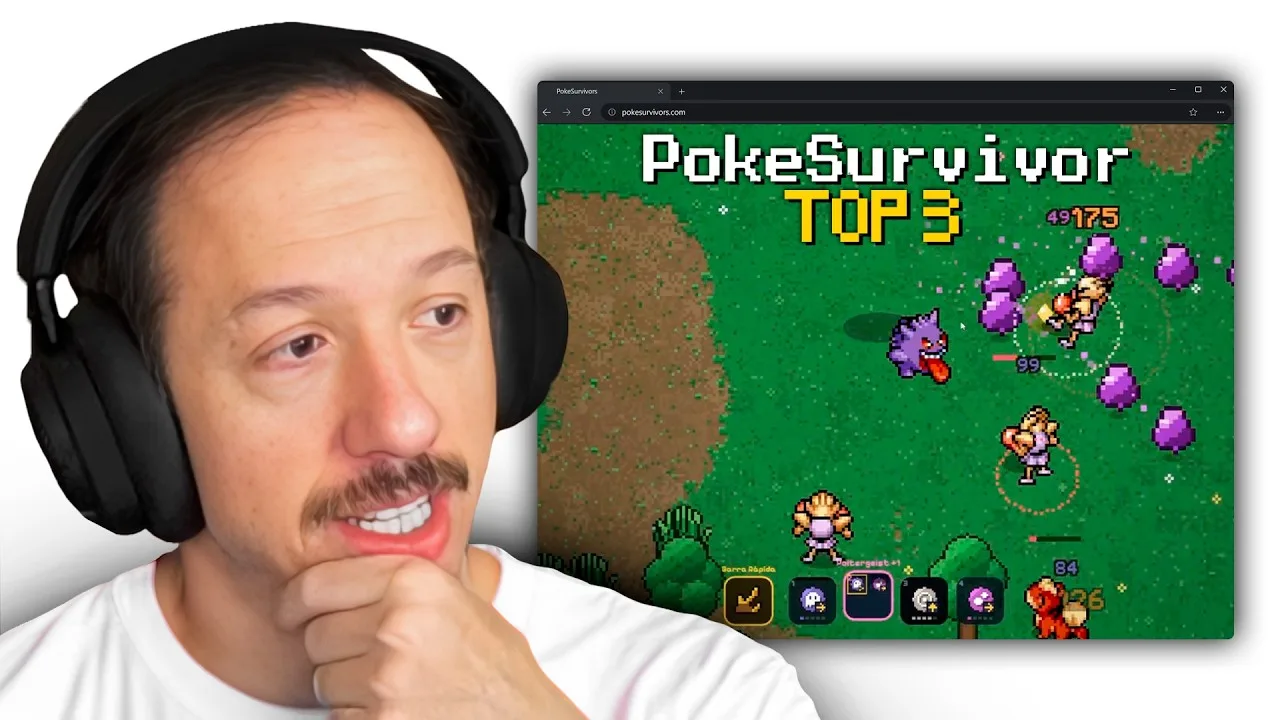
Movement drives PokéSurvivor gameplay because enemies approach from several directions, attack at range, and support one another. Running away without watching the terrain can lead you straight into another group.
Use these habits during your opening runs:
- Move in wide circles. Draw pursuing enemies into a trailing line while checking for openings ahead.
- Keep an escape route visible. Avoid squeezing between obstacles when enemies are already closing behind you.
- Collect experience after creating space. Walk through drops when your attack has cleared a route.
- Leave incoming attack markers immediately. Filling circles and lines on the ground signal attacks about to land.
- Target healers and shield-casters when you can reach them safely. Remove the support keeping nearby enemies alive.
Experience on the ground does nothing for your level until you collect it. However, a large pile is not worth charging through an intact horde. Loop around, keep attacking, and return when the approach opens.
Respond to the problem ending your runs
If fast enemies keep catching you, take movement speed when offered and choose routes with room to maneuver. If enemies reach you because they survive too long, strengthen your active attack. If you clear enemies comfortably but lose health to repeated mistakes, add defense or recovery.
Avoid choosing every offensive upgrade automatically. More damage helps only while you remain alive to use it.
Enemy roles deserve the same attention as enemy numbers. Healers, shield-casters, summoners, exploders, and ranged attackers create different problems. Watch what a group is doing before deciding whether to attack through it or circle away.
Locked chests require you to stay nearby until they open. Clear the surrounding area before committing to one. Leave if the horde closes your escape route; the chest does not justify getting pinned.
Build Around Your Active Move and Plan Evolutions
In PokéSurvivor gameplay, ordinary move slots do not all attack simultaneously. You normally have one active move, with the others available to switch into.
Learning a new move makes it active immediately. Check your move bar after that choice. Selecting a buff or a short-range attack can change your damage output even when you intended to keep using your original projectile.
Strengthen the attack that currently keeps enemies away before spreading upgrades across several unfinished moves. Add another move when its type, range, or effect gives you an answer your main attack lacks.
Follow the move evolution sequence
Move evolution changes an attack into a stronger form. Ember becomes Fire Blast, while Bubble becomes Surf. The game includes 59 different move evolutions.
| Step | Requirement |
|---|---|
| Learn the move | Have the move in your current run |
| Upgrade it | Raise the move to its maximum level, level 5 |
| Take the required boost | Select the specific stat card its evolution requires during that run |
| Choose the evolution | Pick the golden evolution card when offered at a level-up |
Permanent upgrades and held-item bonuses do not replace the required stat card. Keep track of that requirement while selecting rewards instead of waiting until the move is maxed.
Card offers vary, so avoid building your entire survival plan around receiving one particular upgrade immediately. Take useful damage, movement, or defensive boosts when the offered cards do not advance your intended evolution.
Use Bonds to combine attacks
Winning a legendary rift battle grants a Bond, which joins two moves so they fire together and occupy one slot. This changes how you can build around attacks and buffs.
Pair an offensive move with a buff you already use, or combine attacks whose effects complement each other. Keep the selection tied to your existing upgrades; joining two neglected moves does not replace developing your main damage option.
Bonds and evolutions are separate systems. A Bond combines moves, while an evolution transforms an individual move after its requirements are met.
Adjust to Types, Weather, and Held Items
Type matchups affect both your damage against enemies and their damage against you. PokéSurvivor gameplay uses softened multipliers rather than the main-series values.
| Matchup | Damage multiplier |
|---|---|
| Neutral | ×1 |
| Super effective | ×1.6 |
| Not very effective | ×0.6 |
| Main-series immunity | ×0.3 |
| Dual-type interaction | Multipliers combine, capped at ×2.4 |
An Electric move still damages a Ground-type target, but the reduced multiplier makes that matchup inefficient. Switch to suitable coverage when you have it.
Against dual types, consider both parts of the matchup. An attack that is effective against one type can be resisted by the other.
Let weather influence your move choice
Rain boosts Water and weakens Fire; harsh sunlight reverses that relationship. Sandstorm favors Rock, Ground, and Steel. Snowfall favors Ice while other types suffer and slow down. Fog boosts Ghost, Fairy, and Psychic.
Watch for weather changes before assuming your build has suddenly become weak. Switch to an available move that fits the conditions, while still checking whether it handles the enemies nearby.
Read held-item tradeoffs before equipping
You can hold one item at a time. Items appear in chests and from defeated bosses, last for the run, and force a choice when another item drops.
| Held item | Effect |
|---|---|
| Leftovers | Restores 1.5% of HP per second |
| Choice Band | Adds 40% damage and prevents move switching |
| Quick Claw | Reduces all move cooldowns by 20% |
| Focus Sash | Leaves you at 1 HP after a knockout hit, available every 60 seconds |
| Shell Bell | Heals you through damage dealt |
| Lucky Egg | Adds 30% experience |
| Life Orb | Adds 30% damage, with a small HP cost per attack |
| Choice Scarf | Adds 35% speed |
| Assault Vest | Reduces damage taken by 20% |
| Amulet Coin | Adds 50% PokéCoins at the end of the run |
Equip Choice Band only when you want to commit to your active move. Its switching restriction matters especially when your build relies on changing types or activating buffs.
Check your health before taking Life Orb. Consider whether its damage increase compensates for the ongoing HP cost. When replacing a recovery item, account for the healing you will lose.
Tackle Rifts, Grow Your Collection, and Coordinate Co-op
Rifts bring legendary encounters into PokéSurvivor gameplay. Entering one sends you into an arena associated with the legendary’s type. There are 18 arenas and 87 legendary opponents.
Terrain changes the fight: lava burns, ice is slippery, and water slows movement. Dual-type legendaries randomly use one of their types for the arena.
Check your health and available attacks before entering. During the fight, keep enough room to dodge instead of chasing damage into dangerous terrain. Winning awards a ×10 gacha ticket; losing returns you to the main map without that reward.
Defeating a legendary records battle progress rather than automatically granting that Pokémon as a playable partner. Use the regional gacha to pursue collection unlocks.
Separate collection goals from upgrade spending
The roster contains 966 playable Pokémon across nine regions. Gacha pulls use tickets earned through play, while permanent partner upgrades use coins.
| Collection or progression goal | How it works |
|---|---|
| Unlock additional partners | Spend earned tickets in regional gacha pools |
| Strengthen a favorite partner | Buy that Pokémon’s permanent upgrades with coins |
| Obtain a wild shiny | Defeat a shiny spawn; each spawn has a 1-in-4,096 chance |
| Obtain a gacha shiny | Each pull has a 1-in-100 chance |
| Use an owned shiny | Select its shiny form in your collection |
| Earn achievement rewards | Complete achievement conditions for medals, tickets, and coins |
Spend coins on a partner you actually play. Its permanent upgrades apply only to that Pokémon, so switching partners also means switching upgrade tracks.
Check missions and achievements between runs. The achievement roster contains 130 achievements, including survival milestones, move evolutions, collection goals, and legendary victories.
Keep co-op decisions quick
Online co-op supports up to four players. Add friends by nickname, invite them into your room, and start together. Experience is shared, and standing beside a downed teammate revives them.
Coordinate different attack types and call out support enemies. Before reviving someone, draw enemies away and clear an approach.
Group play continues while your pause menu is open. Keep moving during decisions instead of assuming a menu makes you safe. When the group enters a rift, everyone goes together.
To start a run, play PokéSurvivor in your browser. The game is free, with no ads or purchases, on PC and mobile.
FAQ
What makes PokéSurvivor gameplay different from Vampire Survivors?
Your Pokémon normally attacks with one selected move, so switching attacks is part of combat. Type matchups, weather, move evolutions, and Bonds add further decisions to movement and leveling.
Can I play PokéSurvivor on my phone?
Yes. Hold your phone in landscape, drag to move, and tap move icons to switch attacks. You can also add the game to your home screen.
Why is my max-level move not evolving?
Take the specific stat card required by that move during the current run. Once the move and stat requirement are ready, select the golden evolution card when offered.
Do permanent upgrades carry over to every Pokémon?
No. Each Pokémon has its own permanent upgrades. Coins spent strengthening one partner apply when you play that partner.
Continue with
 PokéSurvivor Guide: Survive Longer and Build SmarterUse this PokéSurvivor guide to learn controls, evolve moves, handle bosses and rifts, earn tickets, and build stronger partners for your next survival run.
More in Guide
PokéSurvivor Achievements: Unlocks, Rewards & Titles
Track all 130 PokéSurvivor achievements, earn tickets and profile titles, and plan your route through collection milestones, rifts, and Arceus challenges.
PokéSurvivor Controls: PC and Mobile Survival Guide
Learn PokéSurvivor controls for PC and mobile, switch moves, pause your run, and dodge enemy swarms with practical tips for smoother browser-game survival.

PokéSurvivor Missions: Daily Tasks and Rewards Guide
Complete PokéSurvivor missions with a clear plan for daily and weekly tasks, stronger builds, mission achievements, and rewards. Make every run count.
Join the community
Official channels for news, updates and player help: