
PokéSurvivor Attacks: Move Evolutions and Build Tips
Your Pokémon automatically uses its active move. Switch between learned PokéSurvivor attacks, explore move evolutions, and plan Bond combinations.
Jump to

How PokéSurvivor Attacks Work
Four learned moves won’t save you if the wrong one is active. PokéSurvivor attacks fire automatically, but your selected move determines whether you’re clearing enemies, building a buff, or dashing into danger. Understanding PokéSurvivor attacks lets you spend level-ups on damage you actually use and switch before a bad matchup closes your escape route.
The basic combat rule is simple: your Pokémon automatically uses its active move. Other learned moves give you options to switch into. Bonds change that rule by letting linked moves fire together from a single slot.
| Action | PC controls | Phone or tablet controls |
|---|---|---|
| Move | WASD or arrow keys | Drag your finger anywhere on the screen |
| Select a move | Press 1–4 or click its icon | Tap the move |
| Cycle moves | Q/E | Tap the move you want |
| Pause | Esc | Tap the top-right pause button |
Play on mobile in landscape. On either platform, focus on movement and positioning rather than trying to press an attack button.
Learning a new move makes it active immediately. Check the move bar after each selection, especially when picking Swords Dance, Agility, Harden, or Aqua Ring. These moves build stats instead of dealing damage, so leaving one selected changes what your Pokémon is doing.
Collect the experience enemies drop to earn another level-up. Each level offers three cards covering new moves, move upgrades, or Pokémon boosts. Walk through cleared ground to collect those drops; killing enemies without collecting their experience leaves your build waiting for its next upgrade.
Official page: PokéSurvivor (pokesurvivor.com)
Choose Attacks by Their Shape and Effect
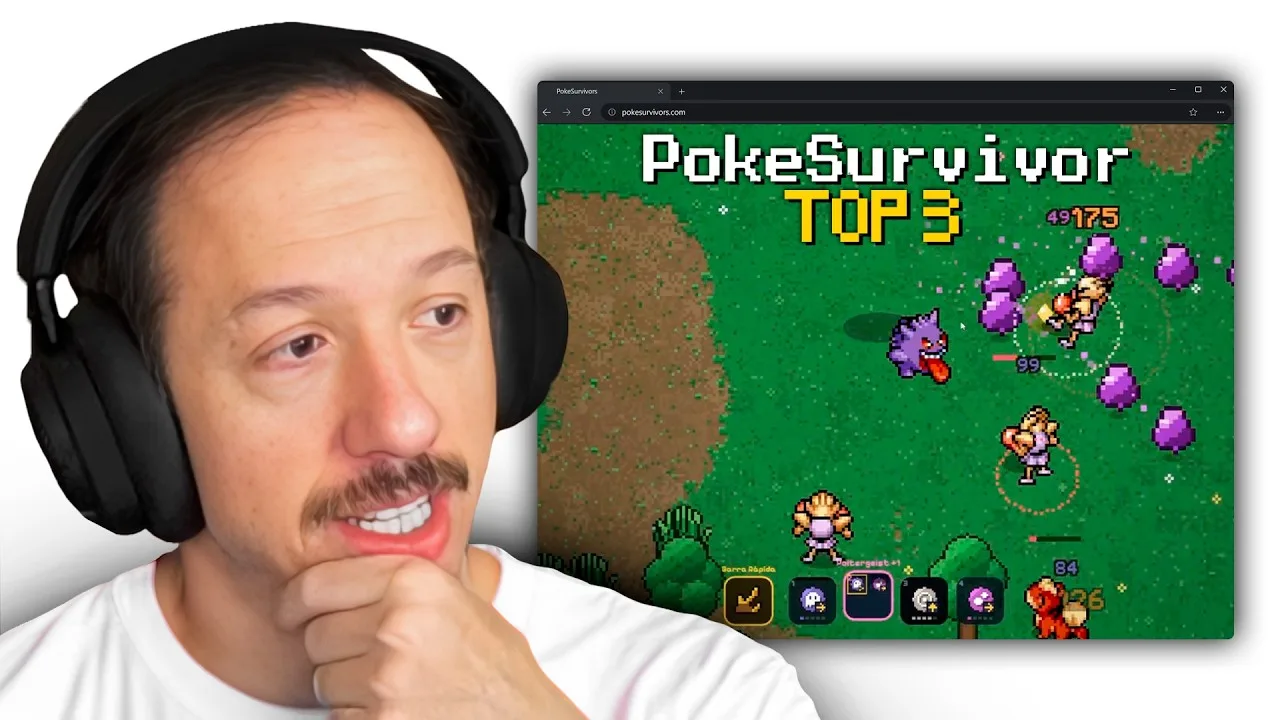
PokéSurvivor attacks include projectiles, beams, orbiting defenses, ground effects, and buffs. Start by asking what the attack actually hits. An impressive damage upgrade still requires enemies to enter that move’s range.
| Attack pattern | Examples | What the move does |
|---|---|---|
| Projectile | Ember, Water Gun, Confusion | Ember targets the nearest enemy; Water Gun pierces; Confusion homes in |
| Burst | Hyper Voice, Bubble, Mud Shot | Sends attacks outward; Bubble and Mud Shot also slow enemies |
| Orbit | Fire Spin, Petal Blizzard, Gust | Keeps rotating attacks around your Pokémon |
| Aura | Grass Knot, Discharge, Bulldoze | Damages nearby enemies; Grass Knot snares and Bulldoze slows |
| Beam | Hydro Pump, Ice Beam, Psybeam | Fires a heavy attack along a beam |
| Boomerang | Razor Leaf, Bonemerang, Psycho Cut | Travels outward and returns through enemies |
| Turret | Substitute, Will-O-Wisp | Leaves an attacker behind; Will-O-Wisp also burns |
| Trail or mines | Toxic, Spikes, String Shot | Places hazards along your route or on the ground |
| Buff | Swords Dance, Agility, Harden, Aqua Ring | Builds Attack, Speed, Defense, or health regeneration while active |
Upgrade the move that is already clearing your surroundings before collecting several undeveloped alternatives. Every additional move needs attention, and an inactive slot does not automatically contribute another stream of attacks.
Keep a different attack type available when your partner’s move pool allows it. For example, Grass damage runs into resistance against Bug Pokémon. Switching to a neutral option can address that matchup, though range still matters: Body Slam is a short, slow melee attack.
For orbit and aura moves, circle around groups and let approaching enemies enter the attack’s coverage. Keep watching the ground for incoming attacks; damage surrounding your Pokémon does not prevent enemy hits.
With Toxic or other ground effects, lead pursuers through the area you’ve covered. Then loop toward dropped experience through a cleared opening. Avoid making a tight turn that brings the chasing pack directly across your path.
Quick Attack and Aerial Ace move your Pokémon as part of their attacks. Plan the route around obstacles and enemies before selecting them. These are attacking moves, so don’t assume they behave like a separate emergency dodge button.
Evolve Your Main Move With the Right Upgrade
There are 64 moves and 59 move evolutions. Evolution changes an attack’s coverage, projectile count, reach, or other properties alongside its damage.
Build PokéSurvivor attacks around the upgrade their evolution requires. Taking unrelated stat cards can help survival, but it won’t replace the specific requirement for your chosen move.
Follow this sequence:
- Learn the move during the run.
- Upgrade it to its maximum level, level 5.
- Take its required stat card in that same run.
- Select the gold evolution card when it appears in a level-up offer.
Permanent upgrades and held-item bonuses do not substitute for the required run card. Evolution also requires a selection; reaching level 5 alone does not complete it.
| Base move | Required upgrade | Evolution | Listed evolution changes |
|---|---|---|---|
| Quick Attack | Sprint | Extreme Speed | ×1.9 damage, more distance, less cooldown |
| Body Slam | Power | Giga Impact | ×1.9 damage, more range, 360° coverage |
| Hyper Voice | Reflexes | Uproar | +6 projectiles, ×1.6 damage, +1 pierce |
| Substitute | Armor | Double Team | ×1.8 damage, +1 at a time, faster firing |
| Ember | Power | Fire Blast | ×1.8 damage, +2 projectiles, +2 pierce, larger size |
| Water Gun | Power | Scald | ×1.8 damage, +2 projectiles, +2 pierce, larger size |
| Bubble | Sprint | Surf | +6 projectiles, ×1.6 damage, +1 pierce |
| Razor Leaf | Reflexes | Leaf Storm | ×1.8 damage, +1 boomerang, more range |
| Petal Blizzard | Synthesis | Petal Dance | +2 orbs, ×1.7 damage, more radius |
| Confusion | Reflexes | Psyshock | ×1.8 damage, +2 projectiles, +2 pierce, larger size |
| Psybeam | Power | Future Sight | ×1.8 damage, beam 50% wider and longer |
| Hex | Magnet | Poltergeist | ×1.7 damage, +3 jumps |
Choose the prerequisite when your main move is approaching its maximum. For Razor Leaf, that means Reflexes; for Petal Blizzard, it means Synthesis. Both are Grass attacks, but their evolution requirements differ.
Read the full evolution effect instead of comparing damage multipliers alone. An extra boomerang creates another outgoing and returning attack. Additional chain jumps extend an attack across more enemies. A wider beam changes how much space the attack covers.
Card offers are randomized, so keep strengthening a working build while waiting. If enemies are catching you, take movement or survival help instead of spending every selection on an evolution plan you cannot yet finish.
Use Bonds to Combine Damage and Utility
Bonds let linked moves activate together while occupying one slot. Defeating a legendary in a rift grants a Bond, and you can have up to four Bonds.
This changes how you build PokéSurvivor attacks. Before linking, Swords Dance requires time as the selected move to build Attack. Linking it with a damaging move lets both operate together.
Pair a damage move with a buff
When your partner can learn both, link Confusion with Swords Dance or Water Gun with Swords Dance. Select the resulting slot to fire the attack while building the Attack buff.
Keep investing in the damaging move.
For a regeneration pairing, link Water Gun with Aqua Ring when both are available. Aqua Ring builds health regeneration while active, and Water Gun supplies the damage that Aqua Ring lacks.
Pair Hex with a status effect
Hex deals extra damage to enemies that are burned, poisoned, or slowed. Link it with a move that supplies one of those effects when your partner’s move pool supports the combination.
Toxic creates poisonous ground for pursuers to cross. Pairing it with Hex connects a status effect to an attack that specifically benefits from affected enemies.
Keep the distinction clear: an evolution transforms a move; a Bond links move activation. You can plan for both without treating them as the same upgrade.
Enter rifts with enough health, a functioning attack, and room to maneuver. Legendary arenas have their own terrain and weather: lava burns, ice is slippery, and water slows movement. Prepare for the arena instead of relying entirely on your ability to clear ordinary waves.
In co-op, the game continues while you’re on the pause screen. Make your selections promptly and keep an eye on nearby threats.
Adjust Your Attacks for Types, Weather, and Items
PokéSurvivor attacks use a softened version of the Pokémon type chart. Super-effective hits deal ×1.6 damage, resisted hits deal ×0.6, and matchups that normally grant immunity instead take ×0.3.
Dual-type modifiers multiply, with a ×2.4 cap. These rules apply to enemy attacks against you as well as your damage against them.
Switch according to the enemy you need to remove. Normal attacks still face resistance from Rock and Steel, while Ghost enemies take the reduced immunity modifier. Carrying another type gives you an alternative only if you can switch to it.
Weather adds another reason to reconsider your selected attack.
| Weather | Type effects |
|---|---|
| Rain | Strengthens Water and weakens Fire |
| Harsh sunlight | Strengthens Fire and weakens Water |
| Sandstorm | Boosts Rock, Ground, and Steel; other types suffer |
| Snowfall | Boosts Ice; other types suffer and slow down |
| Fog | Boosts Ghost, Fairy, and Psychic |
Recheck your attack when weather changes. If you have both Fire and Water options, rain favors selecting Water, while harsh sunlight favors Fire.
You can hold one item at a time, found during runs in chests or from bosses. Finding another gives you a choice of which item to keep.
| Held item | Effect |
|---|---|
| Quick Claw | Reduces cooldown on all moves by 20% |
| Choice Band | Adds 40% damage but prevents move switching |
| Life Orb | Adds 30% damage; each attack costs a little HP |
| Shell Bell | Heals you from damage dealt |
| Leftovers | Restores 1.5% of your HP per second |
| Choice Scarf | Adds 35% speed |
| Assault Vest | Reduces damage taken by 20% |
| Lucky Egg | Adds 30% experience |
Check your active move before accepting Choice Band. Its damage bonus comes with a switching restriction, which directly affects builds that alternate between types or buffs.
Preserve movement space even after improving your damage. Prioritize healers and shield-casters, leave filling ground markers, and avoid chasing a reward through a closing gap.
Between runs, spend coins on the partner you intend to keep playing. Permanent upgrades belong to each Pokémon individually; upgrading one does not strengthen the rest of your collection. Build a reliable partner while learning how its attacks control the battlefield.
FAQ
Do all PokéSurvivor attacks fire at the same time?
Ordinarily, only the selected move activates automatically. Bonds let linked moves activate together from one slot. Other learned moves remain available to switch into.
How do you evolve an attack?
Raise it to level 5, take its required stat card during the same run, and select the gold evolution card when offered. Water Gun requires Power to become Scald; Razor Leaf requires Reflexes to become Leaf Storm.
Why did my Pokémon stop dealing damage after a level-up?
Learning a move selects it immediately. Swords Dance, Agility, Harden, and Aqua Ring build stats rather than dealing damage. Check the move bar and switch back to a damaging attack.
Can held items replace evolution requirements?
No. An item’s damage or cooldown bonus does not replace the required run card. Keep item selection and evolution planning separate, and remember that you can hold only one item at a time.
Continue with
 PokéSurvivor Builds: Moves, Items, and Survival TipsPlan stronger PokéSurvivor builds with move evolutions, Bonds, held items, and type coverage. Choose upgrades that keep you alive through hordes and rifts.
More in Builds

PokéSurvivor Evolutions: Move Upgrades & Build Guide
Learn PokéSurvivor evolutions with move upgrade steps, Ember and Bubble paths, held item choices, and Bond tips. Build stronger moves and survive longer.
PokéSurvivor Moves: Evolution Paths and Build Tips
Master PokéSurvivor moves with evolution requirements, attack types, Bond combinations, and held item tips. Plan your upgrades and survive tougher hordes.
PokéSurvivor Upgrades: Smarter Builds for Longer Runs
Master PokéSurvivor upgrades with smarter coin spending, level-up cards, move evolutions, Bonds, and held items. Build a partner that survives longer runs.
Join the community
Official channels for news, updates and player help: